Programme · Global Relay · 2026
Quote-to-Cash: CPQ to ZAB to Stripe
ZAB is NetSuite's master contract automation engine: it tracks what customers bought, at what price, and when to charge them. No manual invoicing required.
The programme I led at Global Relay closed the CRM-to-ERP gap end to end — Salesforce CPQ through Boomi into NetSuite Zone Advanced Billing and Advanced Revenue Management, with Stripe collecting card payments — and retired the legacy CRM, Certinia billing and PSiGate in the process.
By Yousef A. Salam
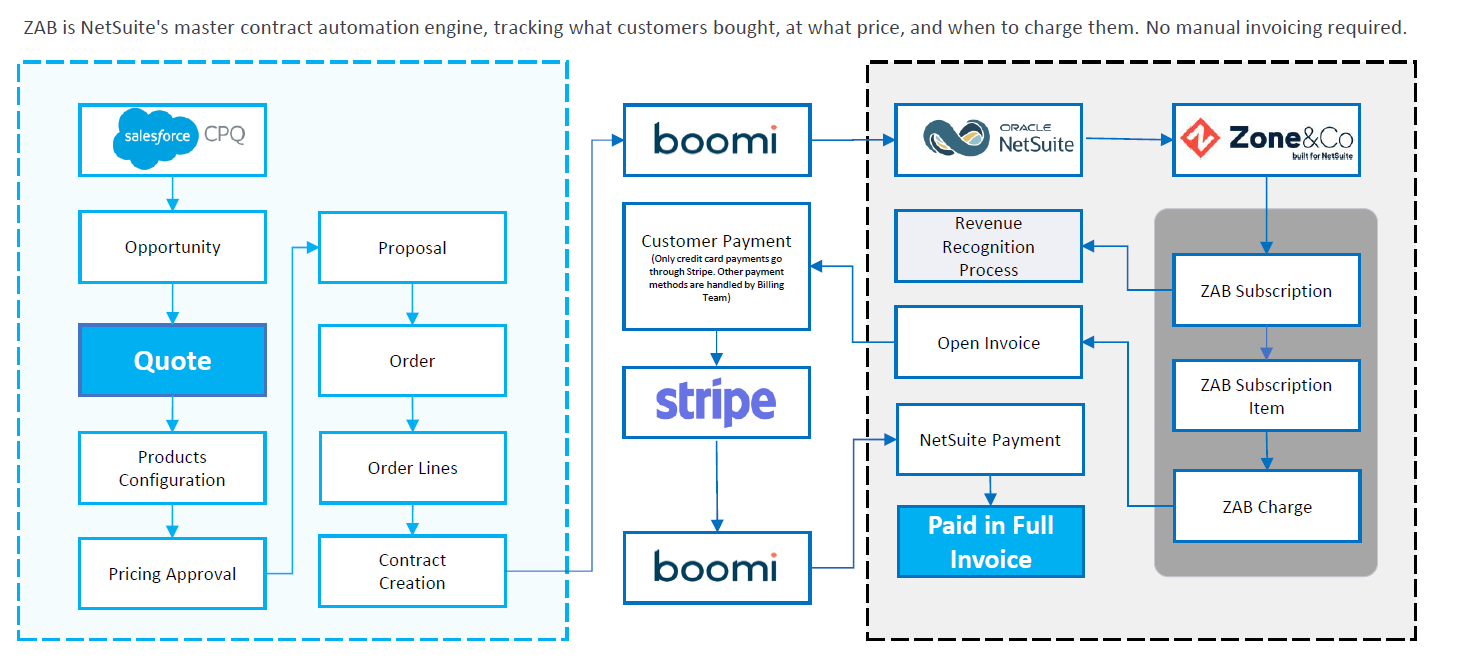
From opportunity to paid in full
-
Stage 01 · Salesforce CPQ
Quote, configure, price, approve
An opportunity becomes a quote; products are configured and pricing runs through approval. Everything the billing engine will later rely on is decided here — term, rate type, quantity, discount — which is why CPQ configuration is a finance-systems decision, not just a sales-tooling one.
-
Stage 02 · Salesforce CPQ
Proposal, order, order lines, contract
The approved quote produces a proposal, then an order with its lines, then a contract. The contract is the hand-off artefact: it is the first object whose shape has to survive translation into a billing subscription without a human retyping it.
-
Stage 03 · Boomi
The integration fabric
Boomi carries the contract into NetSuite and Zone & Co, and carries the settlement result back. One fabric, reusable patterns, and reconciliation designed in — so a failure is a named exception with a payload to inspect rather than a silent gap between two systems.
-
Stage 04 · NetSuite & ZAB
Subscription, subscription item, charge
Zone Advanced Billing turns the contract into a ZAB subscription, its items and its charges — the master contract automation record. From here billing is generated on schedule, and the revenue recognition process draws from the same structure rather than a parallel one.
-
Stage 05 · Stripe & the ledger
Open invoice, payment, paid in full
Charges raise an open invoice. Card payments route through Stripe and return via Boomi as a NetSuite payment, closing the invoice as paid in full; other payment methods stay with the Billing team on the same records. Cash and revenue remain separate concerns throughout.
What changed, and what it took
Three platforms retired
Legacy CRM, Certinia billing and PSiGate payments decommissioned rather than left running alongside the new stack.
No manual invoicing
Invoices are generated from the charge schedule. Billing work becomes reviewing exceptions, not raising documents.
Two integrators governed
External systems integrators held to scope, cost and delivery commitments through SIT, UAT, mock bill runs, migration and cutover.
Audit trail unbroken
Zero-downtime deployment with role-based access, segregation of duties and traceable approvals maintained throughout.
The hard part of quote-to-cash is not the billing engine. It is making sure the commercial terms someone agreed in a quote are the same terms the ledger recognises twelve months later.
Companion piece: NetSuite ZAB and ARM billing processes →