Use case · Billing & revenue
NetSuite ZAB and ARM billing processes
Billing and revenue are two engines running on one ledger. Most subscription accounting problems are not calculation errors — they are the two engines disagreeing about what was sold.
Written from a live Salesforce CPQ → Boomi → NetSuite Zone Advanced Billing and Advanced Revenue Management → Stripe implementation in a regulated global B2B SaaS business.
By Yousef A. Salam
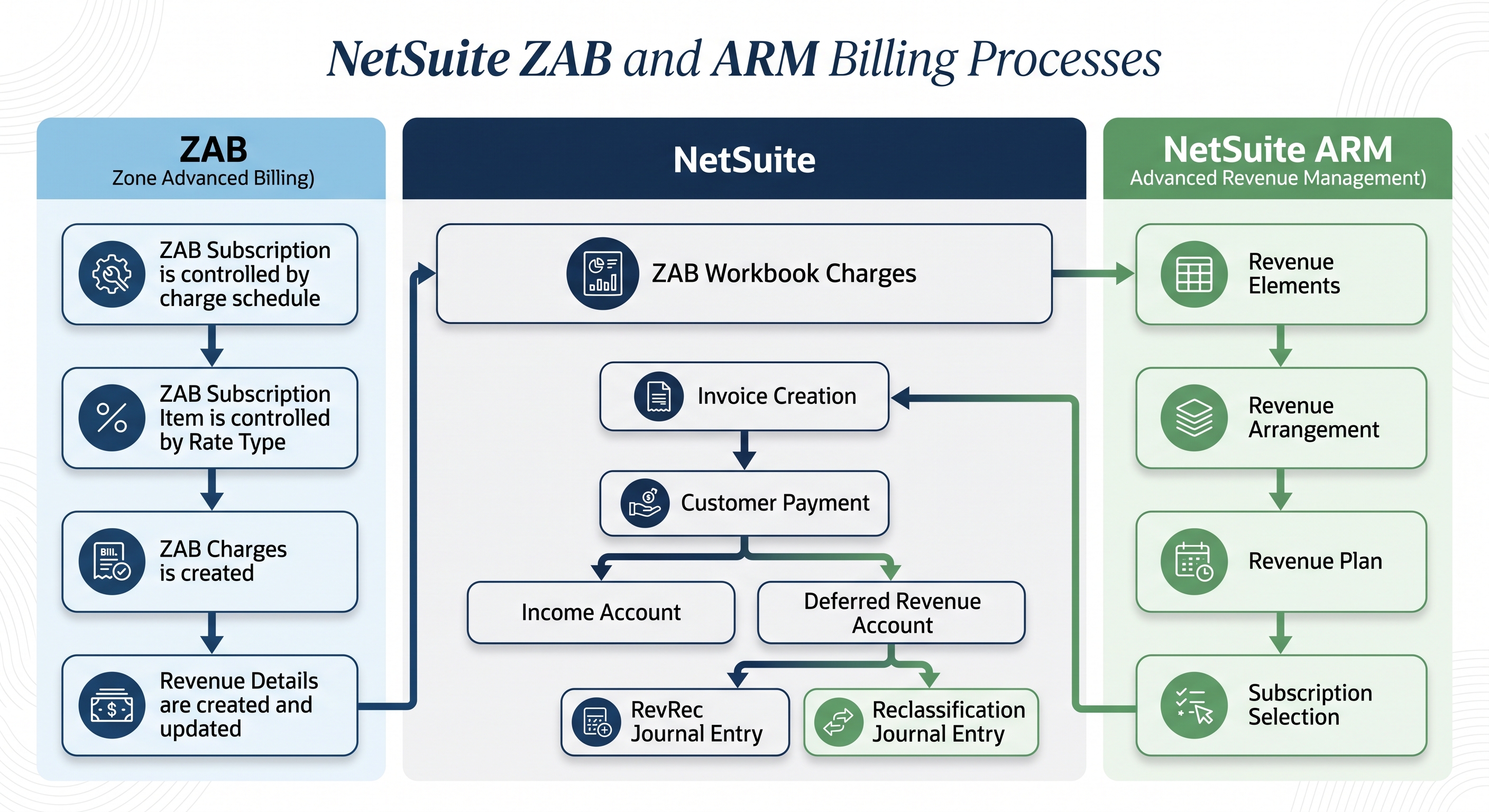
The flow, one step at a time
-
Step 01 · Zone Advanced Billing
The subscription and its charge schedule
A ZAB subscription is controlled by its charge schedule, and each subscription item by its rate type. Get these two wrong and every downstream artefact is wrong in a way that looks like an accounting problem. This is the layer where the commercial terms on the order form become machine-readable.
-
Step 02 · Zone Advanced Billing
Charges and revenue details are created
ZAB generates charges on the schedule and maintains the revenue details that travel with them. The ZAB workbook is the reconciliation surface: if a charge exists here and nowhere downstream, the fault is in the hand-off, not the ledger.
-
Step 03 · NetSuite
Invoice creation and customer payment
Charges become an invoice; payment arrives — in this architecture through Stripe — and posts against it. Cash movement and revenue are already separate concerns at this point, which is precisely what makes the next step possible.
-
Step 04 · Advanced Revenue Management
Elements, arrangement, plan
ARM takes the ZAB workbook charges as revenue elements, groups them into a revenue arrangement, and builds a revenue plan that recognises over the service period — independent of when the invoice was raised or the cash landed.
-
Step 05 · The ledger
Income, deferred revenue, and the two journals
Invoicing splits between the income account and the deferred revenue account. ARM then posts the revenue recognition journal as the service is delivered, and the reclassification journal to move balances between deferred and recognised. Two journals, two purposes — conflating them is the most common source of unexplained balance-sheet movement.
Four places the two engines must agree
Item and rate type
The subscription item's rate type must match the revenue rule the item is configured for, or billing and recognition diverge from the first period.
Service period boundaries
Charge dates and revenue plan start and end dates must be derived from the same contract term — not entered twice.
Mid-term change orders
Upgrades, downgrades and co-terminus additions have to reach both the charge schedule and the arrangement, or the prorated amount is right and the recognised amount is not.
The CPQ hand-off
Compare order-form terms against the billing schedule and revenue arrangement at intake — flag divergence before the first invoice is issued, not after the customer disputes it.
Everything reconciles to the ledger, never the reverse. ASC 606 judgments stay with Revenue Accounting — treatment is proposed, never applied.