Field guide · Twelve layers · Edition 01
How AI is built and controlled
Start with silicon. Follow the chain through computation, learned weights, context and tools. Finish where the difficult question begins: who gets to decide what the system can do?
Each note below is a boundary. Understand what crosses it, what stays behind, and which trade-off appears at the next layer. Approximately twelve minutes.
By Yousef A. Salam
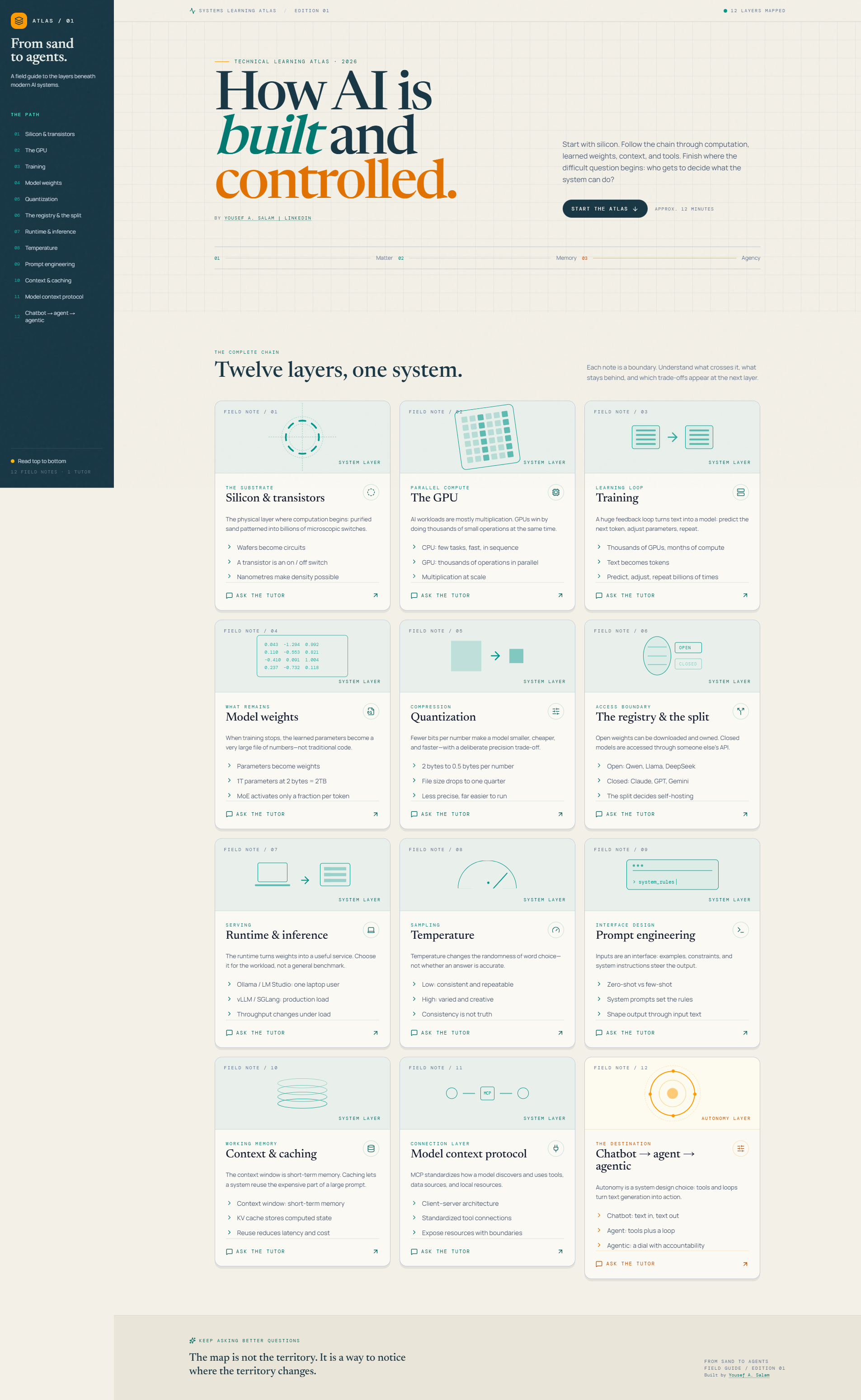
Twelve layers, one system
-
01 · The substrate
Silicon & transistors
The physical layer where computation begins: purified sand patterned into billions of microscopic switches. A transistor is an on/off switch a few nanometres wide, and density is what makes everything above it possible.
-
02 · Parallel compute
The GPU
A CPU does a few tasks fast, in sequence. A GPU does thousands of small operations at the same time. AI workloads are mostly multiplication, so the parallel machine wins — AI is multiplication at scale.
-
03 · Learning loop
Training
Thousands of GPUs and months of compute turn text into a model. Text becomes tokens of roughly three-quarters of a word; the loop predicts the next token, adjusts parameters, and repeats billions of times.
-
04 · What remains
Model weights
When training stops, parameters become weights: a very large file of numbers, not traditional code. A trillion parameters at two bytes each is a 2TB file. Mixture-of-Experts architectures activate only a fraction of it per token.
-
05 · Compression
Quantization
Fewer bits per number make a model smaller, cheaper and faster with a deliberate precision trade-off. Two bytes down to half a byte drops the file to a quarter of its size — less precise, far easier to run.
-
06 · Access boundary
The registry & the split
Open-weight models — Qwen, Llama, DeepSeek — can be downloaded and owned. Closed models are reached through someone else's API. This split decides whether self-hosting is even on the table, which is a procurement and data-residency question before it is a technical one.
-
07 · Serving
Runtime & inference
The runtime turns weights into a usable service. Ollama and LM Studio suit one user on a laptop; vLLM and SGLang suit production load, where the throughput gap becomes an order of magnitude. Choose for the workload, not the benchmark.
-
08 · Sampling
Temperature
Temperature changes the randomness of word choice — not whether an answer is accurate. Low is consistent and repeatable; high is varied and creative. A low setting will repeat the same hallucination every time: consistency is not truth.
-
09 · Interface design
Prompt engineering
Inputs are an interface: examples, constraints and system instructions steer the output. Zero-shot versus few-shot is a design decision; the system prompt is where the house rules live.
-
10 · Working memory
Context & caching
The context window is short-term memory. Caching lets a system reuse the expensive computed state of a large prompt instead of paying for it again, which is where latency and cost are actually won.
-
11 · Connection layer
Model context protocol
MCP standardises how a model discovers and uses tools, data sources and local resources: a client-server architecture that exposes resources with explicit boundaries. In a finance estate this is the layer where segregation of duties is enforced.
-
12 · The destination
Chatbot → agent → agentic
A chatbot is text in, text out. An agent adds tools plus a loop, so it can change system state. Agentic is a dial, not a thing: suggest to a human, act then seek approval, or act alone and escalate exceptions.
Autonomy is set by whoever owns the process, the budget and the accountability — not by the engineer.
What this means inside a regulated finance function
Exception-based accounting
Humans deployed against anomalies, not volume. Throughput scales without headcount scaling with it.
Autonomous verification, human authorisation
An agent may gather, match and recommend. It does not authorise a payment or post a journal.
Audit-traceable reasoning
Every action writes its inputs, rule, confidence and approver. If it cannot be evidenced, it does not ship.